

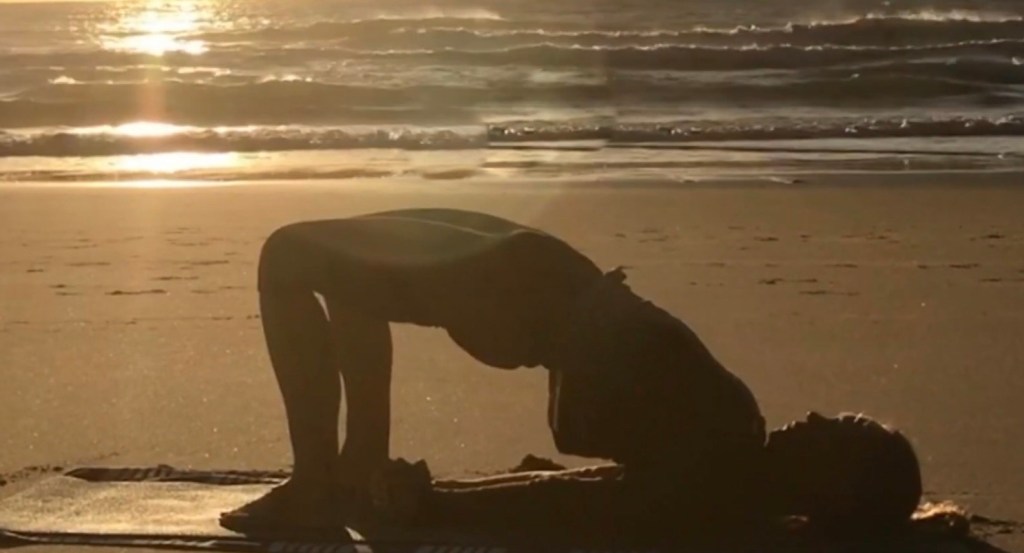
The bridge reaches from head to heart, and then to the soles of our feet. It connects a grounded mind to self-expression, to a lifted heart, to strength at our centre, to creativity and sensuality, and back down to earth.
The bridge reaches the base chakras to heaven – here I am! A fragile, basic human lifting my sun to the sky. Yet my feet are firmly planted on the ground.
In the lines between are all the subtle physical connections. The soft face and the long neck. The gentle distribution of weight to the shoulders and upper arms. The slight engagement of the deep core and pelvis to make space for the spine – the mighty river that flows through and along spinning wheels of energy and light; connecting sun and moon, tail to crown.
The alignment of the knees to remain on course, straight ahead, no distraction. The heels lifting to allow toes to dig into our home, the earth.
And all along, we curl up and down like a beautiful snake; vertebrae like piano keys; a slow undulation towards vitality, silent music.
Building a bridge from earth to heaven and back again.
Through tide and time, we keep courageously rebuilding this bridge.
Namaste, Annie
#WordPrompt
Pose of the month and perhaps the most multi-beneficial pose (asana) in the yoga tradition – the simple bridge.
Potential benefits of bridge pose (Setu Bandha Sarvangasana):
Setu, meaning ‘bridge’ – Bandha, meaning ‘to bind or lock’ – Sarva meaning ‘all’ – Anga, meaning ‘limb’ – Asana, meaning ‘pose’
• Strengthens back extensors, gluteals, legs and ankles
• Opens the heart
• Stretches the neck, shoulders, chest, hip flexors and spine
• Calms the mind, alleviates stress and mild depression
• Rejuvenates organs including the lungs and thyroid
• Invigorates tired legs
• Stimulates digestion
Bridge Pose Steps:
- Lie on your back in reclined mountain pose.
- Bend the knees upward and bring the feet hip-width apart underneath the hips. Place the arms on the floor beside you with the hands – palms down – next to the hips.
- Press into the big toes to awaken awareness of the inner line of the leg. Lift the tailbone, lower back, the mid-back and then the upper back towards the sky. Do this vertebra by vertebrae, and as you raise the torso engage the lower abdominals, pulling in and up on the pelvic floor. This slight engagement supports the lumbar spine.
- With the hips raised. the balance of the body falls on your feet. shoulders and upper arms. Bring strength to the legs by tightening the gluteals at the sitting bones and pressing into the feet.
- Coming up onto the toes releases the frontal fascia and facilitates space to lift the hips higher. Then, lower and press into the heels if possible.
- Broaden the collarbones, rolling the shoulders away from the ears. This action opens the chest. Bring the shoulder blades a little closer together to distribute weight to the triceps. While aware of a slight chin lock, lengthen the back of the neck.
- Interlace the fingers, bringing the arms together and pressing them into your mat.
- Remain in this pose for around five breaths.
- To come out of the pose, unclasp the hands and bring them beside the hips, broadening the shoulder blades. Bring the back down to the mat gently, starting with the upper back, then middle back, lower back and finally the tailbone, releasing vertebrae by vertebrae. Extend the legs and relax in corpse pose (Savasana).
- Neutralise the spine by taking the feet wide and resting the knees together for two or three breaths, then bend the knees wide and rest the feet together ro two or three breaths, before bringing the knees into the chest as a counter pose – options to roll the knees in a circle in each direction to massage the lower back.
Modifications
- Place a blanket underneath the shoulders and neck to avoid stress to the neck and upper spine.
- Hands can be placed around the ankles for a supported sensation.
- Hands can be placed underneath the sacrum to initiate additional lift.

- Raise the hips and place a block, small bolster or firm cushion underneath the lower back, then relax in a supported bridge. An option is to extend the legs and gently engage the abdominals to achieve a relaxed hip flexor stretch.
Progressions
- Once in bridge, raise one leg to the sky, with the knee bent or leg straight, keeping the hips aligned.
- Raise both arms straight up to the sky.
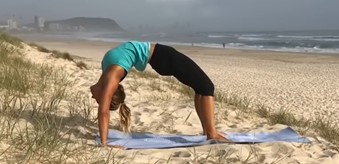
- Progress to full wheel pose.
Sources
- Long, R., Anatomy for Backbends and Twists, Bandha Yoga Publications
- Various articles by Keller, D., via www.doyoga.com

 Ascension Active
cool post! I like it extends beyond the physical, from head to heart and from earth to heaven. pictures really helped for the literal execution of this bridge, thank you. you can check out my bridge posts at http://www.mtothe5th.wordpress.com; Grace Day
LikeLiked by 1 person